project details
SBMD Care provides online urgent care, telemedicine appointments, prescription services, wellness care etc. The goal was to build a professional, trustworthy, user‑friendly website that:
- Clearly communicates their services (urgent care, internal medicine, wellness care, etc.)
- Makes appointment booking intuitive and fast
- Conveys reliability, empathy and medical professionalism
- Works responsively on desktop, tablet, mobile
- Is easy for the client to maintain / update content (blogs, FAQs, service pages)
Case Information
Design Phase (Figma)
Research & Discovery
Competitor / Industry Benchmarking: Review other telehealth / urgent care websites to see what works: homepage layouts, service detail pages, trust markers (testimonials, insurance info, doctors credentials), color palettes, imagery.
User Personas: Defined at least two personas — e.g. “Adult with urgent non‑emergency issue needing same day online appointment”, “Wellness‑oriented user looking for preventive care or internal medicine follow up”.
Information Architecture & Wireframes
*Mapped out the site structure: Home, About, Services (with subpages), Blog, Contact, Areas Served, FAQ, Testimonials.
Low‑fidelity wireframes to decide placement of appointment‑booking buttons, how to present major services, how to display trust (insurance, testimonials), etc.
Visual Design in Figma
Style / Branding: Selected a clean, professional palette (medical / blue / white tones likely), typography that’s readable and trustworthy.
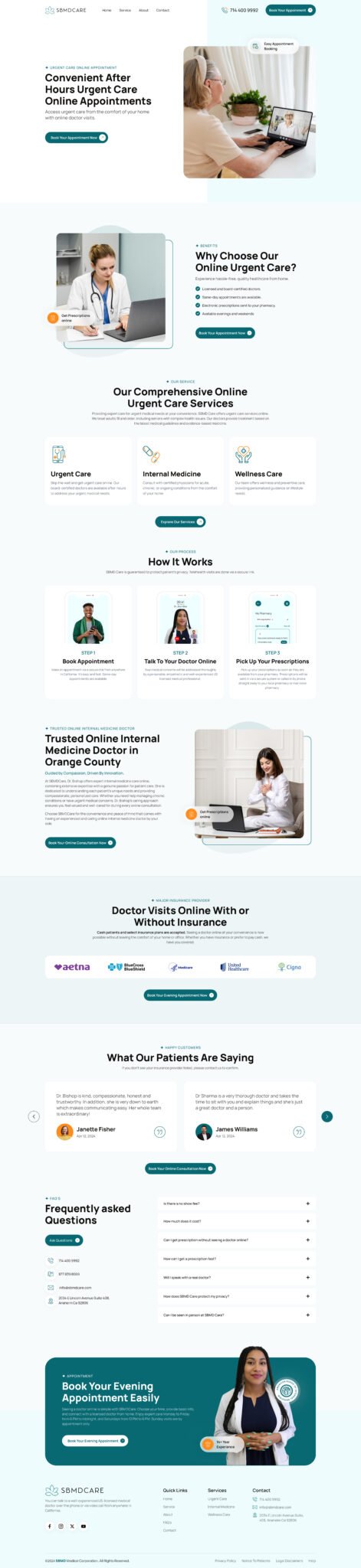
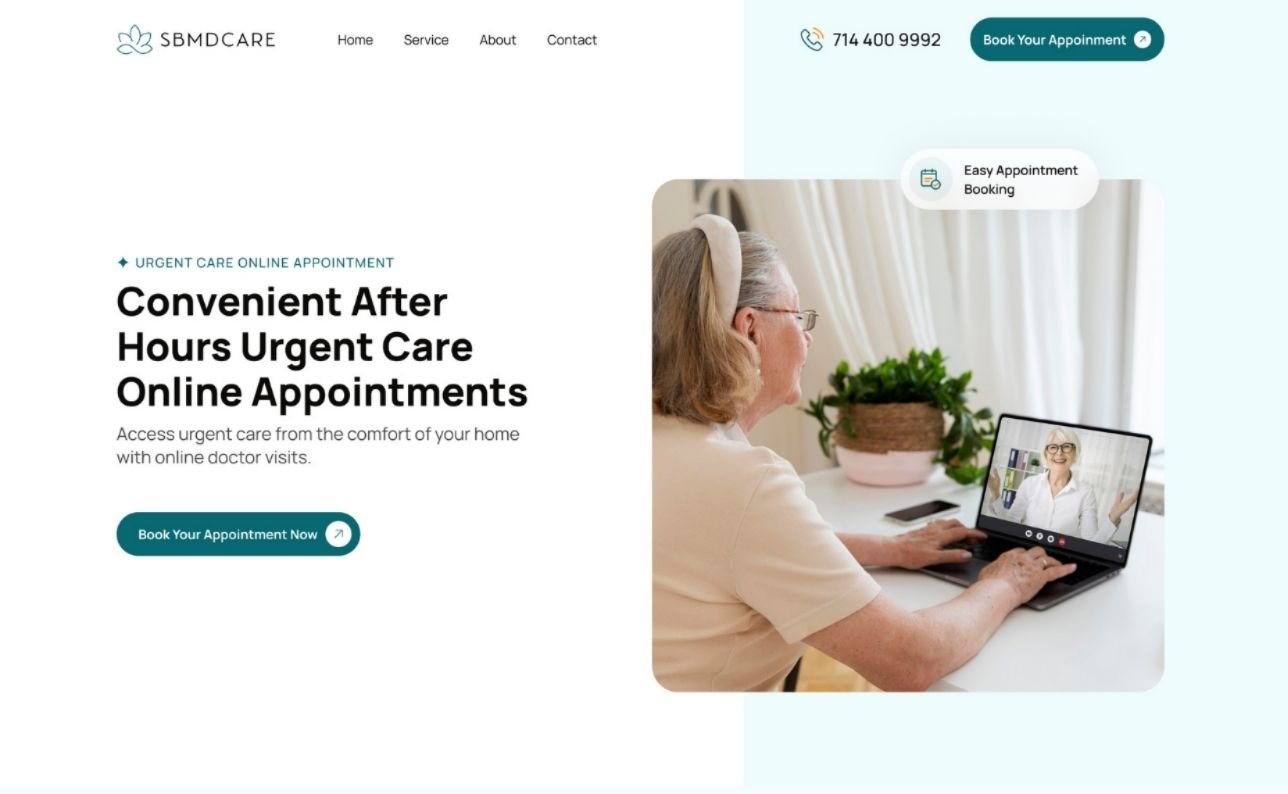
Homepage Layout: Hero section with clear call‑to‑action (“Book Appointment”), benefit statements (“Licensed board‑certified”, “Same day” etc.), imagery showing care / telehealth, followed by services, process steps, testimonials, FAQs.
Mockups for service pages, FAQ, contact page. Ensured responsive design—layouts for desktop, tablet, mobile.
Prototype / User Flow: From homepage → service details → booking flow. Feedback cycles to ensure the flow is intuitive and no friction.
Development Phase (WordPress)
Setup and Technologies
Chosen WordPress as CMS for ease of content updates (blog, FAQs, service pages).
Likely used a premium or custom theme to match the Figma design, or built custom via theme development / child theme.
Plugins/extensions:
Booking / appointment plugin (integrated with external system or custom form)
Contact / inquiry forms
Security / privacy (important for telehealth)
Image optimization, caching for performance
Responsive behavior (CSS frameworks or custom media queries)
Implementation
Homepage development: translating Figma designs into HTML / CSS / JS in WP theme templates.
Responsive adjustments: Ensuring menus, images, grids adapt.
Content population: Adding text, images, testimonials, FAQ content.
SEO basics: Proper headings (H1, H2…), meta titles/descriptions, alt text for images, fast load times.
Performance & Access: Ensuring fast load, good mobile experience; ensuring compliance with legal / privacy requirements (HIPAA / local laws if relevant).
Challenges & Solutions
| Challenge | Solution & Learnings |
|---|---|
| Ensuring trust & credibility visually (since telehealth) | Use of testimonials, insurance logos, doctor credentials; keeping tone empathic; clean professional imagery; secure book‑appointment buttons. |
| Booking / third‑party integration | If using external system (like “Tebra” as seen on site), ensure consistent styling and smooth, secure redirection or embed. Test thoroughly. |
| Image / content load times, responsive behavior | Minimize image sizes, use lazy loading; test cross‑device; adjust breakpoints. |
| Keeping legal / privacy concerns in mind | Clearly display privacy / legal disclaimers, contact information; ensure HIPAA or relevant compliance if needed; secure forms and data transmission. |
Outcomes & Metrics (Hypothetical / Observed)
User Engagement: Lower bounce rate on homepage due to clear value proposition and strong CTA.
Conversion: Increase in online appointment bookings / calls.
Mobile performance: High usability / good performance on mobile / tablets.
Content Maintenance: Site owner able to update blogs, FAQs, service pages without developer support.
What Worked Well
Clear hierarchy of information: users know what services exist, how to book, what to expect.
Strong CTA visibility (“Book Appointment / Online Consultation”) throughout.
Trust‐building elements: testimonials, insurance logos, doctor credentials.
Design consistency and responsive behavior.
Areas for Improvement / Future Enhancements
Speed optimization: Further reduce load times (optimize scripts, reduce unused CSS/JS).
Accessibility: Check WCAG compliance (color contrast, keyboard navigation, alt text).
Booking flow: Maybe embed more of the booking within site rather than redirecting, to reduce drop‑off.
Localization / Multi‑State Expansion: As the service aim is expanding beyond California, possible multi‑state pages or geofencing content.
More interactive elements: e.g., Live chat / chatbot for immediate queries.
Analytics & user feedback: Set up tools to measure which pages users drop off; A/B test headline, CTA placements; gather more reviews.
Conclusion
SBMD Care’s website design + development is a strong example of how clarity, credibility, and user‑focused design can work well in a telehealth context. Using Figma to design clean, professional layouts, and WordPress for a maintainable, content‑driven website, the project met goals of usability, trust, and conversion. With ongoing optimizations (performance, accessibility, expansion), it can continue to perform well as SBMD Care grows.